
What is OUM’s USMLE Pathway?
The USMLE Pathway is for students who intend to practice in the United States. USMLE Pathway students must pass the USMLE Step 1, heavily focused on the Basic Sciences, before beginning clinical rotations, and must pass USMLE Step 2 to graduate from medical school. Students typically complete OUM’s MD Program in ~5 years.
What is OUM’s USMLE First-Time Pass Rate?
OUM students have had a 100% first-time pass rate for USMLE Step 2 since the launch of the USMLE Prep Program and our first-time USMLE Step 1 pass rate is 85% as of January 2026.
The USMLE Pathway Typically Takes ~5 Years to Complete.
The Standard Pathway includes the Pre-Clinical Phase, presented through live, interactive, instructor-led virtual classrooms; the Transition Phase, which prepares students for transition to clinical rotations; and the Clinical Phase, which includes core and elective rotations, as well as clinical exams.
The USMLE Pathway includes the Pre-Clinical, Clinical Transition, and Clinical Phases:
-
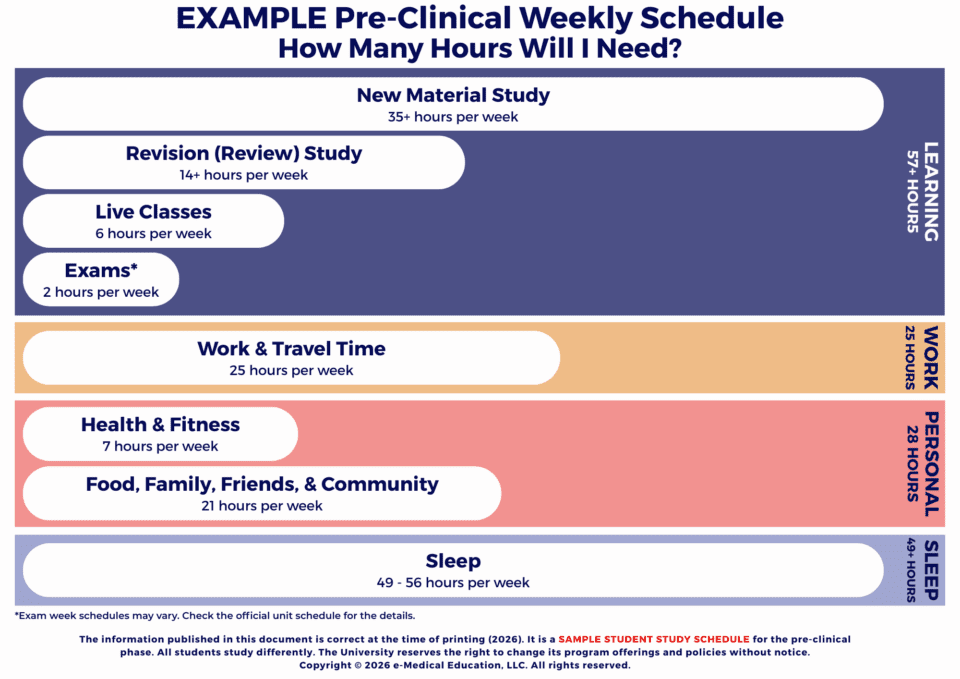
The Pre-Clinical Phase (~2 years) is presented through live, interactive, instructor-led virtual classrooms.
-
The Clinical Transition Phase (~1 year) prepares students to transition to clinical rotations.
-
The Clinical Phase (~2 years) includes core and elective rotations, as well as clinical exams.
Pre-Clinical Phase
The Pre-Clinical Phase of the curriculum includes:
- General Principles Unit
- 9 Organ System Units
- Journal Club Sessions and Presentation
- Ethics and Methods in Research Unit
General Principles Unit
The 8-week General Principles Unit, following Orientation, provides introductions to a number of basic sciences, including Cell Biology, Biochemistry, Genetics, Anatomy and Physiology, Immunology, Microbiology, Pathology, and Pharmacology.
Organ System Units
In 9 Organ Systems, students build on the foundational knowledge gained during the General Principles Unit. As students progress through each Organ System, they develop and improve clinical reasoning skills and apply their knowledge to medical scenarios depicting unique, as well as common, human conditions and ailments. Basic sciences are integrated throughout the units, providing students with material that combines the basic and clinical sciences in a Problem-Based Learning (PBL) case format.
- Cardiovascular
- Urinary
- Pulmonary
- Endocrine
- Neuroscience
- Heme-Immune
- Reproduction
- Gastrointestinal
- Musculoskeletal
Journal Club
Once in practice, doctors must be able to read and understand the implications and possible role in patient care of information found in medical journals. OUM pre-clinical students must participate in Journal Club meetings, which involve the presentation of a peer-reviewed article, followed by faculty-led discussion. Students must present at least once during Organ Systems and attend at least 50 sessions in total, with a minimum of 30 during pre-clinical years.
Session Attendance
While attendance isn’t mandatory, joining live virtual sessions is the best way to stay fully engaged and to earn the 5% of your grade dedicated to class participation. To find out more about class times, please visit the OUM Class Timetable section of the Accepted Applicants page.

Clinical Transition Phase
The Clinical Transition Phase serves as a crucial bridge between the knowledge gained during your preclinical studies and the hands-on experience of clinical rotations. It focuses on preparing you to apply core medical concepts in real-world clinical settings while introducing you to medical specialties.
After completing all Organ System Units in the Pre-Clinical Phase of the MD Program, students progress to the Clinical Transition Phase (~1 year), which includes:
-
Clinical Transition Unit 1 (CTU 1)
-
United States Medical Licensing Examination (USMLE) Step 1 Prep Course
-
National Board of Medical Examiners (NBME) Comprehensive Basic Science Exam (CBSE)
-
USMLE Step 1
-
Clinical Transition Unit 2 (CTU 2)
-
Submitted Research Proposal and Presentation*
*Students must submit their research prospectus before entering the Clinical Phase.
This phase is designed to ensure a smooth transition to clinical rotations by reinforcing medical knowledge and essential clinical skills.
-
CTU 1 focuses on integrating concepts from Health Sciences.
-
CTU 2 introduces students to Medical Specialties and concludes with a hands-on, in-person week to assess competency.
The CTUs follow a fully asynchronous, competency-based learning model with engaging modules. The total duration is 16 weeks (8 weeks per unit), though students may complete them at an individualized pace.
-
USMLE Prep Program
Students in the USMLE Pathway must pass the USMLE Step 1 exam to begin clinical rotations, and the USMLE Step 2 exam to graduate from medical school. Residents of Canada must pass the National Assessment Collaboration Exam (NAC).
To ensure exam readiness, OUM has developed an extensive Prep Program to prepare its students for both examinations.
The Prep Program consists of the USMLE Step 1 and Step 2 Prep Courses. The cost for both courses is included in student tuition.
Clinical Phase
The Clinical Phase is ~2 years and includes:
- Clinical Core Rotations
- Grand Rounds
- USMLE Step 2 Prep Course, NBME CCSE, USMLE Step 2 or MCCQE Part 1
- Clinical Elective Rotations
- FCE OSCE or NAC
- Publishable Research Project
- Pathway 3
Clinical Rotations
The clinical curriculum consists of 72 weeks of core and elective clinical rotations at affiliated teaching hospitals or clinics.
Core Rotations
The core clinical rotations take 56 weeks to complete and their durations are:
- Family Medicine (8 weeks)
- Emergency Medicine (4 weeks)
- Internal Medicine (10 weeks)
- Obstetrics and Gynecology (8 weeks)
- Pediatrics (8 weeks)
- Psychiatry (8 weeks)
- Surgery (10 weeks)
Length of the USMLE Pathway
The Clinical Phase is up to 100 days longer for USMLE Pathway students, who must take the USMLE Step 2 Prep Course, NBME Exam, and USMLE Step 2.
Elective Rotations
Students complete 16 weeks of elective rotations.
Note: One 4-week mandatory core or elective rotation must be completed in Samoa.
Monthly Grand Rounds
As part of your clinical education, you’ll take part in Grand Rounds, which are live, interactive sessions held via Zoom once a month. These sessions give you the opportunity to present and discuss real clinical cases, explore complex and unique patient scenarios shared by peers and faculty, and strengthen your diagnostic and communication skills in a collaborative setting.
During the clinical years, students are expected to attend at least 13 live Grand Rounds sessions.
Research Project
Completing a research project, including writing a publishable quality manuscript, is a graduation requirement. Several resources are available to assist students in preparing for and completing their project including the Ethics and Methods in Research Unit, Research Advisors, Research Club, Journal Club, Library, and the Research Committee.
Pathway 3:
- Per the ECFMG website, Pathway 3 is chosen when, “Applicant’s medical school is currently accredited by an agency recognized by the World Federation for Medical Education (WFME).”
- OUM is currently accredited by PAASCU, which is recognized by WFME. See the Accreditation page for details.
- Please visit the ECFMG website for the latest information on requirements, application procedures, and deadlines.
Final Clinical Assessments
Once core rotations are completed, USMLE Pathway students must pass the USMLE Step 2 and the Objective Structured Clinical Examination (OSCE) as graduation requirements. Completion of elective rotations, also a graduation requirement, can be facilitated throughout one’s clinical curriculum, dependent upon possible prerequisites and/or permission from the student’s Regional Dean.
The University reserves the right to change its program offerings and policies without notice.
USMLE Pathway Students, Graduates & Faculty
See the following pages to find out more:
- Graduate Success Stories for graduate testimonials and videos.
- Student Life for student testimonials and videos.
- Upcoming live webinar and on-demand webinars to meet faculty, deans, students, and graduates.